Pre-submission checklist for research articles
Completing your research article is a major achievement, but submitting it requires a separate round of preparation. A manuscript can contain valuable findings and still be returned before peer review because of missing declarations, incorrect formatting, incomplete author information, or overlooked submission requirements.
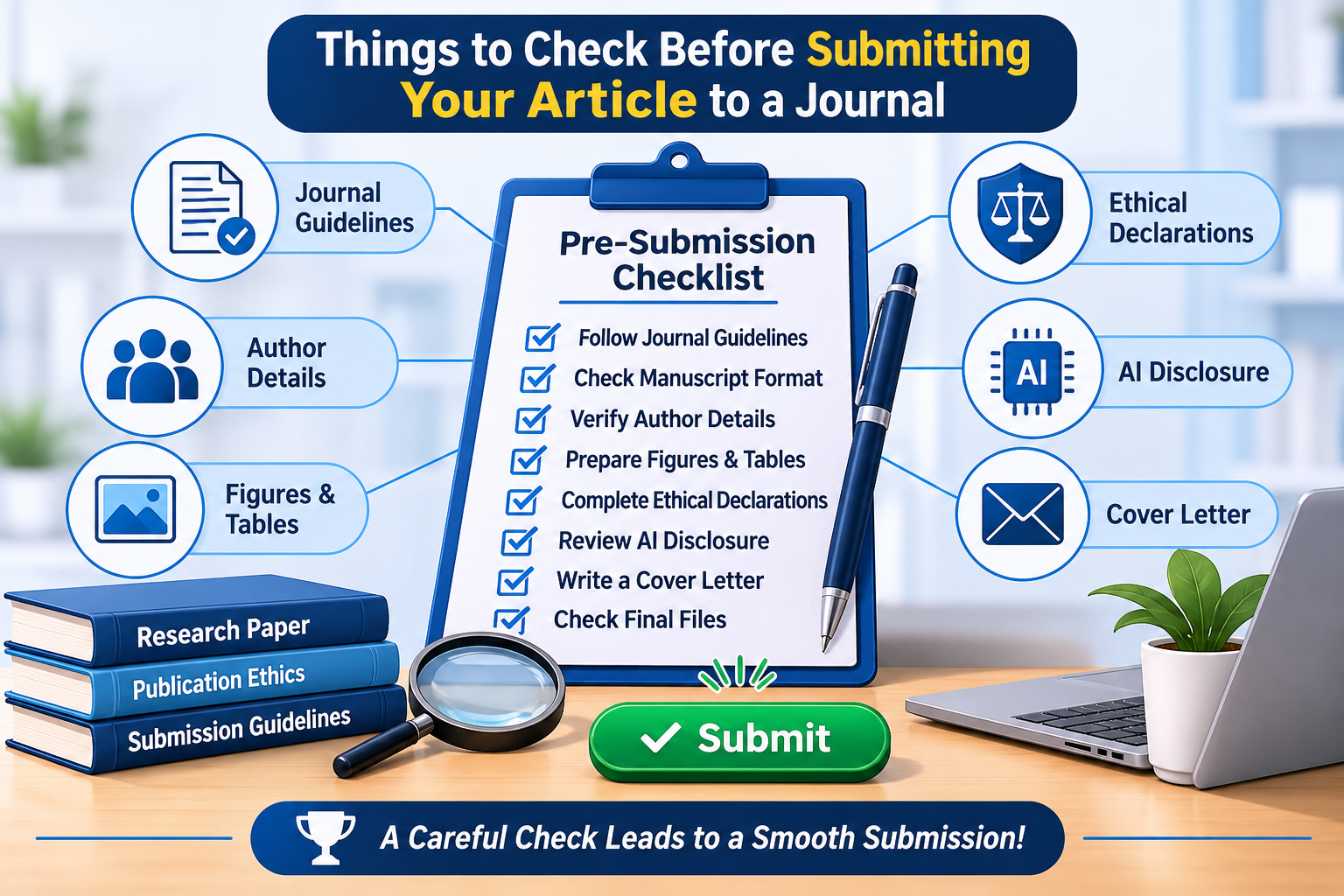
Before clicking the Submit button, review the manuscript, supporting documents, publication ethics, and journal-specific instructions. This final pre-submission checklist will help you identify common problems and prepare your research article for editorial assessment.
1. Have You Checked the Journal's Submission Requirements?
Before uploading your manuscript, verify the journal's latest instructions for authors. Every journal has specific requirements, and following the format of another journal does not guarantee compliance.
Check these requirements on the journal's official website:
- Article type: Does the journal accept original research, review articles, short communications, case reports, or your particular manuscript category?
- Word count: Does your manuscript meet the permitted length?
- Abstract: Does the journal require a structured or unstructured abstract?
- Keywords: How many keywords are permitted?
- References: Which referencing style does the journal follow?
- Figures and tables: Are there restrictions on their number, format, resolution, or placement?
- Additional documents: Does the journal request highlights, a graphical abstract, supplementary information, or reporting checklists?
Do not assume that the guidelines you downloaded several months ago are still current.
My recommendation: Revisit the official author instructions immediately before submission. A journal may update its requirements, and an old template may no longer be suitable.
If you want to understand how to interpret these requirements, read our guide on author guidelines before submission. It explains what researchers should check and why overlooking these instructions can create avoidable delays.
2. Is Your Manuscript Properly Structured and Formatted?
A manuscript should follow a logical structure and meet the formatting requirements of the target journal.
For many original research articles, the standard structure is Introduction, Methods, Results, and Discussion (IMRAD). However, review articles, case reports, and other manuscript types may follow different structures.
Use this table to review your manuscript:
| Section | What to check |
|---|---|
| Title | Accurate, specific, and representative of the research |
| Abstract | Consistent with the methods and actual findings |
| Keywords | Relevant to the research topic |
| Introduction | Background, research gap, and study objective |
| Methods | Sufficient detail about the research methodology |
| Results | Accurate presentation of findings |
| Discussion | Interpretation, comparison with previous studies, and limitations |
| Conclusion | Supported by the actual research findings |
| References | Accurate citations and consistent formatting |
Pay particular attention to the relationship between your abstract, results, and conclusion.
For example, if your abstract reports a particular experimental outcome, that result should be supported by the main manuscript. Similarly, your conclusion should not introduce claims that your experiments have not demonstrated.
Check the following formatting details:
- Font type and size.
- Line spacing and margins.
- Page and line numbering.
- Heading levels and numbering.
- Figure and table placement.
- Reference formatting.
- Abbreviation definitions.
If you need help organizing your manuscript, read our guide on the structure of a research paper. It explains the purpose of each section and common structural mistakes.
For help refining the abstract, you can also read our guide on how to write an abstract for a research paper.
3. Have All Authors Reviewed and Approved the Manuscript?
Authorship should be finalized before submission, not negotiated after the editorial office raises questions.
Incorrect author details or disagreements about authorship can complicate the publication process.
Review these points:
- Confirm that every author's full name is spelled correctly.
- Verify institutional affiliations.
- Confirm the agreed author order.
- Check the corresponding author's email address.
- Include ORCID identifiers where requested.
- Prepare author contribution statements if required.
- Obtain approval of the final manuscript from all authors.
- Confirm that every listed author accepts responsibility for their contribution.
Authorship should reflect genuine scholarly contributions and accountability. General supervision, administrative assistance, or funding alone does not automatically qualify someone for authorship.
The ICMJE recommends four authorship criteria covering substantial contribution, drafting or critical revision, final approval, and accountability. Read the ICMJE recommendations on authorship if you are uncertain about authorship responsibilities.
Do not change author order or add or remove authors without discussing the change with everyone involved and following the journal's policy.
4. Are Your Figures, Tables, and Supplementary Files Ready?
Figures and tables often contain the most important information in a research article. Incorrect labels, missing legends, poor image quality, and incomplete supplementary files can create problems during editorial assessment.
Figure checklist
- Confirm that every figure is cited in the manuscript.
- Check figure numbering and order.
- Verify image resolution and file format.
- Check labels, units, legends, and abbreviations.
- Ensure that the images accurately represent the original data.
- Obtain permission for previously published material where necessary.
Table checklist
- Confirm that every table is mentioned in the manuscript.
- Check numerical values against the original data.
- Use consistent units and decimal places.
- Define abbreviations in table footnotes.
- Avoid unnecessary duplication between tables and figures.
Supplementary material checklist
Some journals request supplementary figures, datasets, videos, protocols, or additional experimental results.
Before uploading, confirm that:
- Every required supplementary file is available.
- File names are descriptive.
- Files open correctly.
- Every supplementary item is cited in the main manuscript.
- The uploaded content matches the manuscript descriptions.
Do not assume that files are correct simply because they appear in your submission folder. Open them individually and inspect their contents.
5. Have You Completed All Required Ethical Declarations?
Publication ethics is one of the most important parts of manuscript preparation. Editors need sufficient information to understand how the research was conducted and whether relevant ethical requirements were followed.
Depending on your research and journal, you may need the following declarations:
| Declaration | What to verify |
|---|---|
| Ethics approval | Appropriate institutional or review board approval, where applicable |
| Informed consent | Consent information where required |
| Animal research | Relevant animal ethics approval |
| Clinical trial registration | Registration information where applicable |
| Funding statement | All relevant financial support |
| Conflict of interest | Relevant financial and non-financial competing interests |
| Data availability | Where and how supporting data can be accessed |
| Acknowledgments | Appropriate recognition of contributors |
For example, research involving human participants may require an ethics approval statement and informed consent information. Similarly, animal experiments may require the relevant institutional approval details.
Never copy an ethics statement from another publication. Your declarations must accurately describe your own research.
The ICMJE recommendations provide guidance on research ethics, disclosure, and manuscript preparation.
6. Have You Checked AI Use and Publication Ethics?
AI-assisted writing and research tools have introduced additional considerations for manuscript preparation. Before submitting your article, check the journal's current policy on the use of artificial intelligence.
Consider the following:
- AI-assisted writing: Does the journal require disclosure if you used AI tools for language editing, drafting, or rewriting?
- AI-generated images: Are AI-generated or AI-modified figures permitted? Does the journal require disclosure?
- Data and references: Have you independently verified every result, citation, reference, and factual statement?
- Authorship: Have you ensured that no AI tool is listed as an author?
- Originality: Does the manuscript accurately represent your own research and analysis?
AI tools cannot take responsibility for the accuracy, originality, or integrity of a research article. Authors remain accountable for the complete submitted manuscript.
Do not assume that every journal follows the same AI policy. Read the publisher's and journal's latest instructions and disclose AI use wherever required.
You can consult the ICMJE guidance on AI use by authors for further information.
7. Is Your Cover Letter Ready?
A cover letter introduces your manuscript to the journal editor. It should briefly explain what the article is about, why it is relevant to the journal, and confirm important submission declarations where requested.
Before submitting, check that your cover letter includes:
- The manuscript title.
- The article type.
- A brief explanation of the research and its relevance.
- Why the manuscript may interest the journal's readership.
- Confirmation that the manuscript is original, where applicable.
- Confirmation that it is not under consideration by another journal.
- Any other declarations requested by the journal.
Keep the letter professional and specific to the target journal. Avoid making exaggerated claims about the importance or impact of your findings.
A generic cover letter sent to multiple journals may not communicate why your research is suitable for a particular publication.
If you need help preparing one, read our guide on how to write a cover letter for journal submission.
8. Have You Checked the Final Submission Files and Online Form?
Even after preparing the manuscript, the online submission process requires careful attention. Many journals ask authors to upload separate files and enter manuscript information into an online system.
Before clicking Submit, verify the following:
- Upload the correct manuscript file.
- Upload figures separately if required.
- Add supplementary files in the correct categories.
- Upload the cover letter and other requested documents.
- Enter the title and abstract accurately.
- Add all authors in the correct order.
- Check affiliations and corresponding author details.
- Select the correct article type and subject classifications.
- Complete all required declarations.
- Review the automatically generated submission PDF.
Final file check:
| Item | Checked |
|---|---|
| Main manuscript uploaded | ☐ |
| Figures and tables included as required | ☐ |
| Supplementary files uploaded | ☐ |
| Cover letter attached, if required | ☐ |
| Author details verified | ☐ |
| Ethics and funding declarations completed | ☐ |
| Submission-system metadata checked | ☐ |
| Generated PDF reviewed | ☐ |
| All authors approved the final submission | ☐ |
If the journal uses double-anonymous peer review, check the manuscript and relevant supplementary files for identifying information.
This may include author names, institutional affiliations, acknowledgments, document properties, and identifying information in figure files.
Follow the journal's instructions carefully. Do not remove information from files that are supposed to contain author details.
Never approve a submission PDF without opening it. Incorrect symbols, missing figures, broken formatting, and incomplete pages can become visible only after document conversion.
A Practical Pre-Submission Decision Checklist
Before submitting, work through these questions in order.
| Question | If yes | If no |
|---|---|---|
| Does the journal accept your article type? | Continue | Find another suitable journal |
| Does the manuscript follow author guidelines? | Continue | Correct formatting |
| Have all authors approved the manuscript? | Continue | Obtain approval |
| Are ethical declarations complete? | Continue | Complete declarations |
| Are figures and supplementary files ready? | Continue | Prepare missing files |
| Is the cover letter ready? | Continue | Prepare the letter |
| Have you checked the final submission PDF? | Submit when all requirements are met | Review and correct it |
This process is designed to catch administrative and technical problems before submission. It cannot guarantee acceptance, but it can help you avoid preventable mistakes.
My Take: A Strong Manuscript Deserves a Careful Submission
Researchers often spend months completing experiments, analyzing results, and preparing manuscripts. However, the final submission process sometimes receives very little attention.
I think this is where many authors make an avoidable mistake.
A technically strong paper does not automatically satisfy a journal's formatting, administrative, and ethical requirements. Missing declarations, incorrect files, and incomplete author information can delay editorial assessment.
My advice is to treat journal selection, manuscript preparation, and final submission as separate tasks.
Do not leave the final checks until the last few minutes before a submission deadline. Give the manuscript a dedicated review, preferably with another author checking the files independently.
A thorough audit takes additional time. However, that time is better spent checking your submission than correcting preventable problems after the editorial office contacts you.
If your manuscript has already faced a rejection, our guide on why manuscripts get rejected explains common problems and how to approach your next submission.
Frequently asked questions
What should I check before submitting a research paper?
Check the journal's scope, article type, author guidelines, manuscript formatting, author information, references, figures, tables, ethics approval, funding, conflicts of interest, and supplementary files. Confirm that all authors have approved the final version and review the generated submission PDF.
Should I format my manuscript before choosing a journal?
You can prepare a general manuscript draft first, but final formatting should follow the selected journal's instructions. Different journals may have different abstract structures, reference styles, word limits, figure requirements, and supplementary file rules.
Is a plagiarism or similarity check necessary before submission?
A similarity check is a useful quality-control step, but its percentage should not be interpreted in isolation. Review matched passages to identify inappropriate overlap, missing citations, reused text, and legitimate similarities such as standard terminology.
Do all journals require a cover letter?
No. Some journals request a cover letter, while others collect the necessary information through an online submission form. Check the target journal's instructions and provide all requested declarations.
Can I submit my manuscript to two journals simultaneously?
No. Simultaneous submission of the same manuscript to multiple journals is generally prohibited under standard publication ethics policies. Wait for a final decision or formally withdraw the manuscript before submitting it elsewhere.
Should I disclose the use of AI in my research paper?
Follow the target journal's current AI policy. Some publishers require disclosure of AI-assisted writing, image generation, or research-related applications. Authors remain responsible for checking the accuracy, originality, and integrity of the submitted work.
Comments
No comments yet — be the first to share your thoughts.
Leave a comment