New Journals Added to Web of Science: November 2026 List
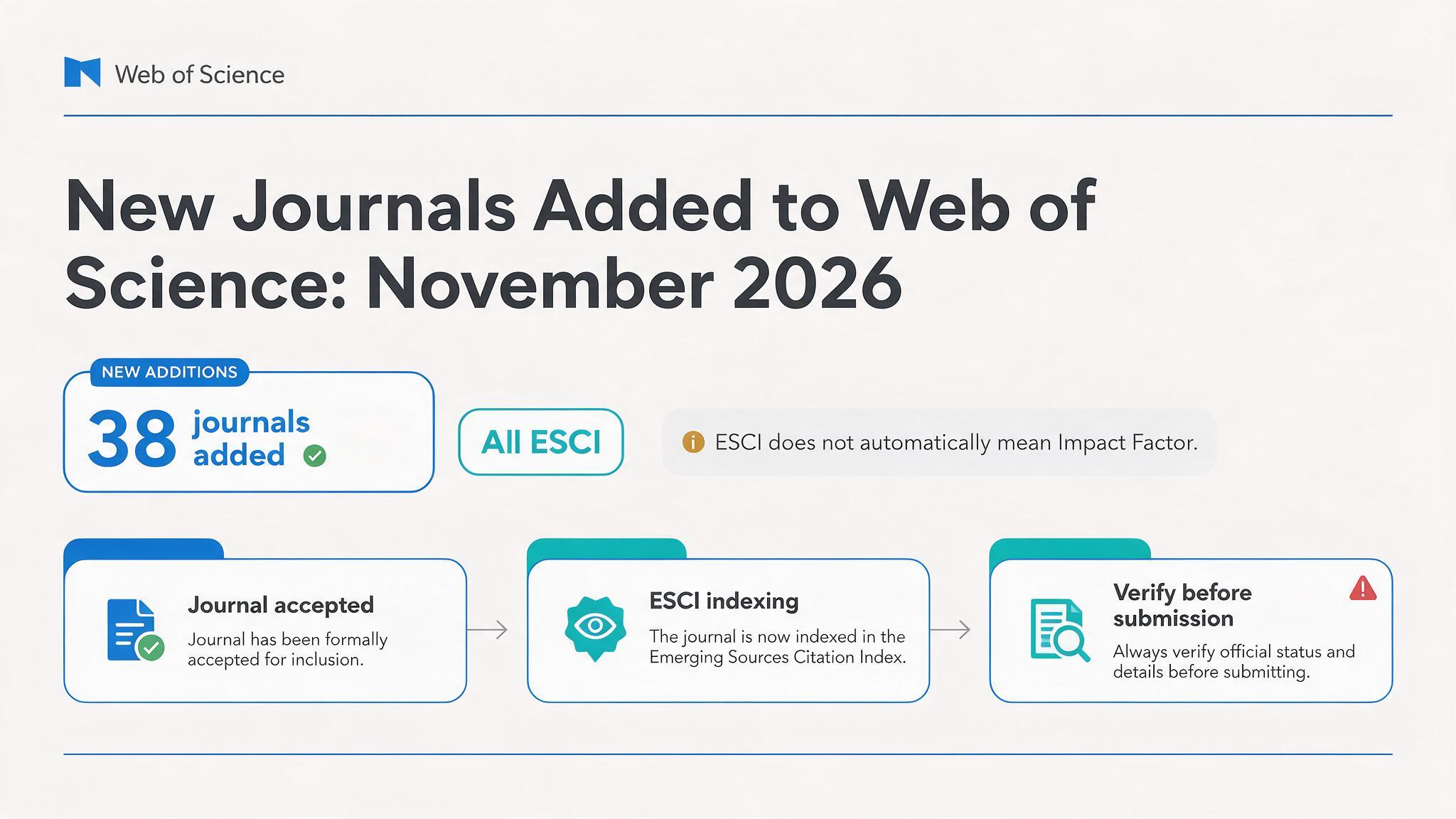
Clarivate’s Web of Science Core Collection reportedly added 38 journals on 16 November 2026, according to Journal Searches. All 38 titles were placed in the Emerging Sources Citation Index, or ESCI, while two journals were reportedly removed.
Direct answer: The November 2026 update reportedly added 38 journals to the Web of Science Core Collection, all in ESCI. ESCI inclusion can improve discoverability, but it does not by itself mean a journal has an Impact Factor or is the right home for your manuscript. Verify the journal’s current status before submission.
Which journals were added to Web of Science?
The reported update includes journals from Elsevier, Springer Nature, Taylor & Francis, IEEE, MDPI, Oxford University Press, Frontiers, and the Royal Society of Chemistry. The complete list below is based on Journal Searches’ report of Clarivate’s 16 November 2026 update.
| # | Journal title | Publisher | Reported index |
|---|---|---|---|
| 1 | Round Table | Taylor & Francis | ESCI |
| 2 | IEEE Solid-State Circuits Magazine | IEEE | ESCI |
| 3 | International Journal of Technology, Knowledge and Society | Common Ground Research Networks | ESCI |
| 4 | Journal of Open Research Software | Ubiquity Press | ESCI |
| 5 | Methods in Psychology | Elsevier | ESCI |
| 6 | Medical Review | Walter de Gruyter | ESCI |
| 7 | Hikma | Editorial Universidad de Córdoba (UCOPress) | ESCI |
| 8 | Journal of Liver Transplantation | Elsevier | ESCI |
| 9 | Revista de Arquitectura | Universidad de Chile | ESCI |
| 10 | European Journal of Health Communication | University of Zurich | ESCI |
| 11 | Computers in Human Behavior: Artificial Humans | Elsevier | ESCI |
| 12 | hLife | Elsevier | ESCI |
| 13 | Blood Neoplasia | Elsevier | ESCI |
| 14 | Science of Traditional Chinese Medicine | Lippincott Williams & Wilkins | ESCI |
| 15 | Journal of Intelligent Construction | Tsinghua University Press | ESCI |
| 16 | Blood Vessels, Thrombosis & Hemostasis | Elsevier | ESCI |
| 17 | Anglica Wratislaviensia | University of Wrocław Press | ESCI |
| 18 | npj Spintronics | Springer Nature | ESCI |
| 19 | Dermato | MDPI | ESCI |
| 20 | Frontiers in Ocean Sustainability | Frontiers Media | ESCI |
| 21 | Materials and Interfaces | Scilight Press | ESCI |
| 22 | Advances in Biomarker Sciences and Technology | KeAi Publishing | ESCI |
| 23 | Agrochemicals | MDPI | ESCI |
| 24 | Cell Investigation | KeAi Publishing | ESCI |
| 25 | Cogent Mental Health | Taylor & Francis | ESCI |
| 26 | Emergency Care and Medicine | MDPI | ESCI |
| 27 | EES Solar | Royal Society of Chemistry | ESCI |
| 28 | Frontiers in Chemical Biology | Frontiers Media | ESCI |
| 29 | Frontiers in Tuberculosis | Frontiers Media | ESCI |
| 30 | Informatics and Health | KeAi Publishing | ESCI |
| 31 | Journal of Endometriosis and Uterine Disorders | Elsevier | ESCI |
| 32 | Journal of Government and Economics | Elsevier | ESCI |
| 33 | Nature Reviews Clean Technology | Springer Nature | ESCI |
| 34 | npj Biological Timing and Sleep | Springer Nature | ESCI |
| 35 | npj Biomedical Innovations | Springer Nature | ESCI |
| 36 | Oxford Open Digital Health | Oxford University Press | ESCI |
| 37 | Pets | MDPI | ESCI |
| 38 | Targets | MDPI | ESCI |
Important verification note: Clarivate’s public Collection List Downloads page showed a last-updated date of 19 October 2026 when checked on 19 November 2026. Its detailed monthly change files require a free Master Journal List login, so I could not independently open the underlying November file. Treat the table above as a reported list, then confirm each title in the Master Journal List before relying on it.
What does ESCI mean for authors?
ESCI stands for the Emerging Sources Citation Index. It is one of the indexes within the broader Web of Science ecosystem, and a journal listed there is indexed in the Web of Science Core Collection.
A useful analogy is a probationary or emerging tier rather than a guarantee of elite status. ESCI inclusion signals that Clarivate has accepted the journal into coverage, but it does not automatically confer an Impact Factor, a JCR quartile, or a particular level of prestige.
That distinction matters. A journal can be newly indexed in ESCI and still have no Journal Impact Factor because the metric depends on Journal Citation Reports coverage and citation data. Do not let a colleague equate “ESCI” with “Impact Factor journal” without checking the journal’s current JCR status.
Why the Web of Science update matters
Indexing affects visibility, discoverability, and sometimes institutional requirements. Clarivate describes the Web of Science Core Collection as a curated collection intended to include journals demonstrating editorial rigor and best practice.
For you, the practical effect is narrower than many authors assume. A newly indexed journal may become searchable through Web of Science, but your manuscript still needs scope fit, a credible editorial process, transparent fees, and an audience that will actually read and cite the work.
Indexing is also not permanent. Clarivate says its editors may remove a title if it fails to maintain quality standards, does not comply with ethical standards, or otherwise no longer meets their criteria. [page:4] A journal’s status on the day you submit is more important than its status in a blog post.
Were any journals removed?
Yes. Journal Searches reports that two ESCI journals were removed in the same update: Civil and Environmental Engineering and Journal of Agricultural Extension. Both were reportedly marked for editorial delisting after re-evaluation.
| Journal | Reported Web of Science status | Reported Scopus status |
|---|---|---|
| Civil and Environmental Engineering | Removed from ESCI through editorial delisting | Still indexed |
| Journal of Agricultural Extension | Removed from ESCI through editorial delisting | Still indexed |
This is the blunt part: a journal can remain in Scopus while losing Web of Science coverage. If your department, funder, or thesis committee requires Web of Science indexing specifically, Scopus coverage alone may not satisfy the requirement.
Does ESCI indexing make a journal a good choice?
No. ESCI indexing is one useful signal, not a complete quality assessment. A newly indexed journal may be an excellent fit for your work, but the index status alone cannot tell you whether its peer review is rigorous, its editorial board is active, or its publication fees are fair.
Here is where I think most authors go wrong: they treat a database badge as a substitute for reading the journal. A journal can be newly indexed and still be a poor match because its aims and scope, article types, review speed, APC, or readership do not fit your paper.
A better test is simple: could you name three recent papers in that journal that resemble your contribution in question, method, and intended reader? If not, keep looking.
How to check a journal before you submit
- Search the exact title in the Web of Science Master Journal List. Confirm that the journal is currently listed and note the specific index, such as ESCI, SCIE, SSCI, or AHCI.
- Read the aims and scope against your abstract. Look for your research problem, methods, and intended contribution, not merely overlapping subject keywords.
- Check the article type. A journal may accept research articles but not reviews, case reports, short communications, negative results, or computational papers.
- Check fees and access options. Identify whether the journal is subscription-based, hybrid, fully open access, or diamond open access, and find the APC before you invest weeks in formatting.
- Check recent issues. Look for papers close to yours in topic and method. This tells you more about editorial fit than a quartile label.
- Use a journal finder as a shortlist generator. Paste your abstract into a journal finder to generate a manageable set of candidates, then verify each result independently.
- Save evidence of the indexing status. Take a dated screenshot or export the journal profile. If indexing changes later, you will have a record of what you checked before submission.
A journal finder tool is most useful at step 6. It should narrow a large field of options into a shortlist; it should not make the final decision for you.
What changed in 2026?
The reported November 2026 change is notable because all 38 newly accepted titles were assigned to ESCI rather than SCIE, SSCI, or AHCI. That matters because ESCI is often the entry point for journals newly entering Web of Science coverage.
Clarivate’s public Master Journal List page also emphasizes that selection and re-evaluation decisions rest with the Web of Science Editors. The company states that publishers remain responsible for editorial management, business practices, and ethical publishing standards.
For authors, the practical message is that indexing news has a shelf life. A journal added in November can be removed later, and a journal removed from one index may remain listed elsewhere.
Red flags before choosing a newly indexed journal
Use this checklist before committing weeks to a submission.
| Check | What to look for | Why it matters |
|---|---|---|
| Current Master Journal List status | The journal appears today, not only in an old update | Indexing can change |
| Correct index | ESCI, SCIE, SSCI, AHCI, or another relevant index | “Web of Science indexed” is too vague for many requirements |
| Aims and scope | Your research question and method fit the journal | Scope mismatch causes avoidable rejections |
| Article types | Your format is explicitly accepted | A strong paper can be rejected for the wrong article type |
| Peer-review model | Transparent editorial process and identifiable editorial board | Quality signals should be visible |
| Fees | APC, submission fee, page charges, and waivers are clear | Hidden costs can derail publication |
| Recent content | Similar papers appear in recent issues | Demonstrates real audience fit |
| Institutional rules | Your committee or funder accepts the specific index | ESCI may not satisfy every requirement |
My take
I would not choose a journal merely because it appeared in a monthly Web of Science update. I would treat the update as a prompt to recheck a shortlist, not as a ranking of the best places to publish.
For a PhD student, newly indexed ESCI journals can be reasonable options when the scope is genuinely strong and the journal has a credible editorial process. For someone facing a rigid tenure, promotion, or funding requirement, I would be more cautious: confirm the exact index and current status in writing before submitting.
This advice does not apply equally to every researcher. If your priority is rapid, open dissemination and your institution accepts ESCI, a well-run newly indexed journal may be a sensible choice. If your priority is a specific citation metric or a narrowly defined indexing requirement, do not rely on ESCI alone.
What You Should Do Next
Check the journal you are considering in the Web of Science Master Journal List today, then compare its aims and scope with your abstract. If you need a faster starting point, search your manuscript topic at scientificjournalfinder.com and find your best-matched journal in seconds.
Frequently asked questions
Are all 38 journals newly added to Web of Science ESCI journals?
According to the reported November 2026 update, yes. Journal Searches states that all 38 newly accepted journals entered the Emerging Sources Citation Index, but the underlying Clarivate download requires a login, so confirm each title before relying on it.
Does ESCI indexing mean a journal has an Impact Factor?
No. ESCI indexing and an Impact Factor are different things. A journal may be indexed in ESCI without having a Journal Impact Factor, so check the journal’s current Journal Citation Reports status rather than assuming one from indexing alone.
Is an ESCI journal acceptable for a PhD thesis?
Sometimes, but it depends on your university’s rules. Ask your graduate office or supervisor whether they require Web of Science indexing generally, a particular index such as SCIE or SSCI, or a minimum citation metric.
Can a journal be removed after being added to Web of Science?
Yes. Clarivate says its editors may remove titles that fail to maintain quality standards or do not comply with ethical standards. That is why you should verify the journal’s status immediately before submission.
How do I find a journal for my manuscript?
Start with scope, not prestige. Paste your abstract into a journal finder, filter by subject area and access model, then compare the shortlist with recent articles in each journal. A journal search by abstract can save time, but manual scope checking remains essential.
Comments
No comments yet — be the first to share your thoughts.
Leave a comment