Research Publication Retraction News: What Authors Need
A journal’s indexing status can change faster than an author expects. The latest research publication retraction news includes a call for faster corrections and retractions, a Web of Science hold on a major surgery journal, and a retraction involving a hidden prompt aimed at AI reviewers.
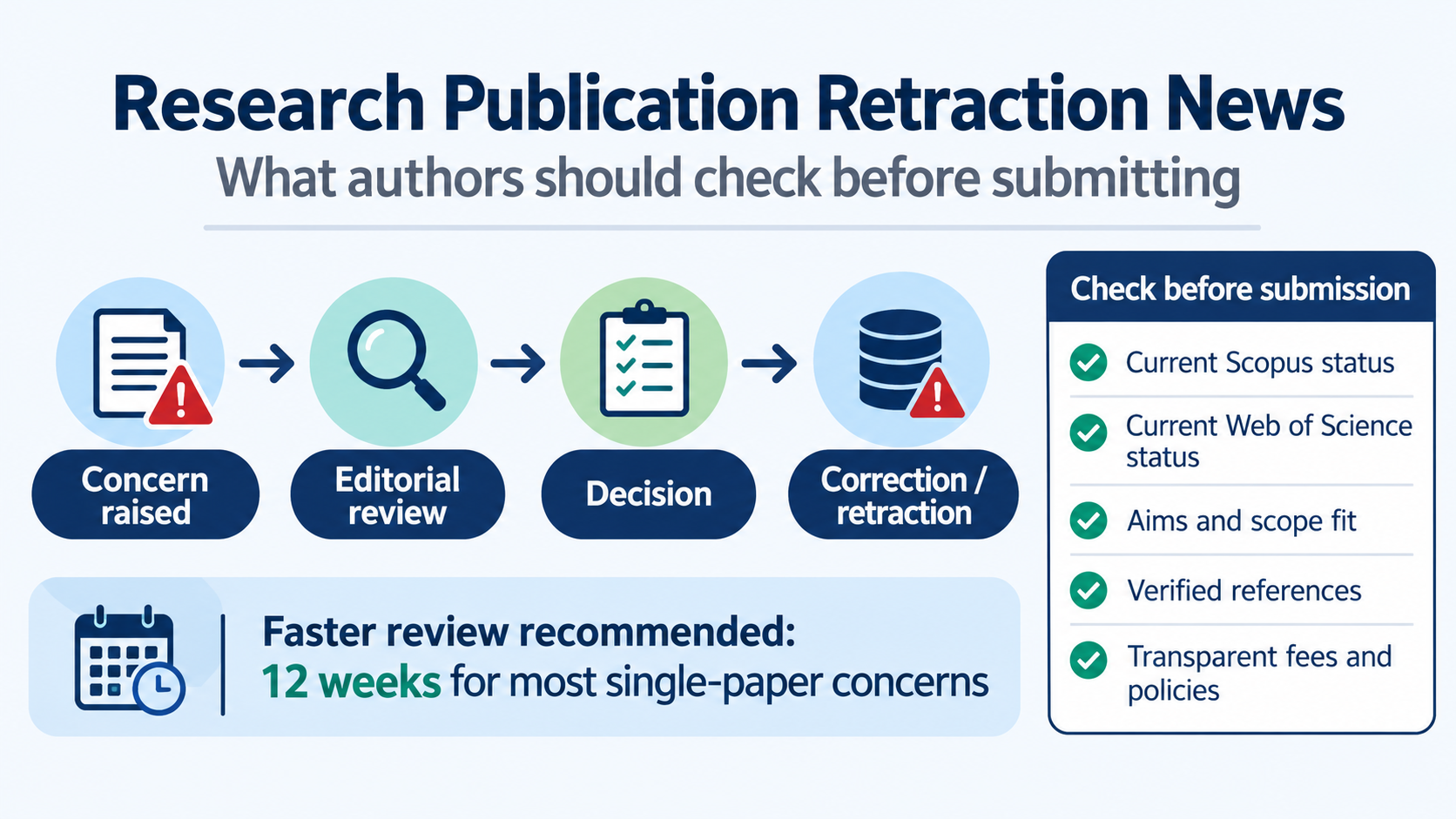
Direct answer: The biggest recent change is pressure on journals to resolve concerns about published papers faster. A new report recommends editorial review within 12 weeks for most single-paper concerns, while indexing bodies continue to reassess journals whose content quality raises concerns. Authors should verify a journal’s current indexing status before submission.
Why retraction news matters
Retractions are not only stories about misconduct. They are signals about whether the scientific record remains reliable, whether a journal responds to problems, and whether a paper should still guide future research.
The U.S. National Academies of Sciences, Engineering, and Medicine reported that retractions occur about 2.4 years after publication on average, based on the Retraction Watch database. Its report recommends that journals complete editorial review of most concerns involving a single paper within 12 weeks, and rarely take longer than six months.
For an early-career researcher, this matters in practical ways. If you cite a retracted paper, build a method on unreliable data, or submit to a journal under integrity review, the cost can appear months or years later.
What a retraction really means
A retraction removes a paper’s status as reliable evidence. It does not automatically prove that every author committed fraud.
The National Academies report emphasizes that journals should distinguish a correction or retraction from a misconduct determination. Honest errors, data problems, authorship disputes, and unverifiable findings can lead to editorial action without a finding of research misconduct.
Think of a retraction as a recall notice. A recalled medicine is not necessarily counterfeit, but it should not be used until the problem is understood and resolved. The same logic applies to a paper whose data, methods, images, references, or conclusions no longer inspire confidence.
Common mistakes authors make
Many authors treat “indexed in Scopus” or “in Web of Science” as a permanent quality certificate. It is not.
Indexing status can change. International Journal of Surgery was reported on November 20, 2026 as placed on hold by Clarivate’s Web of Science, while Scopus discontinued its coverage after 2004–2025. During a Web of Science re-evaluation, newly published content will not be indexed in the Web of Science Core Collection.
Here is where I think most authors go wrong: they choose a journal after seeing an old indexing screenshot, a promotional “indexed in Scopus” claim, or a high impact factor, then skip the current source lists. That is a risky shortcut.
A second mistake is treating a retraction as career-ending misconduct. A retraction can be serious, but the reason matters. The National Academies report specifically calls for separating editorial correction from misconduct findings.
Web of Science journal on hold
“On hold” means Clarivate is reassessing a journal against its selection criteria. It does not mean the journal has been formally delisted, but it does mean new content may not enter the Web of Science Core Collection during the review.
| Status | What it usually means | What I would do |
|---|---|---|
| Indexed | The journal is currently listed in the database. | Confirm the exact collection and current status before submission. |
| On hold | Clarivate is re-evaluating the journal; new content may not be indexed during review. | I would pause unless the journal is essential for my field or my institution explicitly accepts the risk. |
| Discontinued from Scopus | Scopus has ended coverage after a stated period. | I would not treat past Scopus coverage as current Scopus indexing. |
| Retracted paper | An individual article has been withdrawn from the reliable literature. | Check the retraction notice, not just the headline. |
The honest trade-off is this: a journal with a strong reputation may still face an indexing review, while a lesser-known journal may be properly indexed. Your decision should rest on current status, fit, editorial standards, and your institution’s requirements, not on a single metric.
AI peer-review retraction
A recent retraction shows why AI needs careful boundaries in publishing. Retraction Watch reported that a paper in Computer Methods in Biomechanics and Biomedical Engineering was retracted after a hidden prompt designed to influence an AI reviewer was found in the data availability statement.
The reported instruction told an AI system to give the paper a positive review and recommend acceptance. Taylor & Francis told Retraction Watch that the prompt was added in one-point white text, making it difficult to see without close inspection.
This is not a reason to avoid AI entirely. It is a reason to use AI transparently and never to manipulate review. If you use an AI tool for language editing, literature discovery, or code assistance, follow the journal’s policy and disclose use where required.
Fake references remain a problem
Fake or inaccurate references are another recurring integrity issue. The National Academies report itself was delayed after journalists found references with fabricated first names, a possible sign that large language models had been used to write or edit material without adequate checking.
The lesson is simple: verify every reference before submission. An AI-generated reference can look plausible and still point to a paper that does not exist.
For a clinical paper, check the DOI and PubMed record. For an engineering paper, check the DOI and publisher landing page. For a social-science paper, check the DOI, archive record, or publisher page. Do not rely on a reference manager alone.
How to choose a safer journal
Use a journal finder tool as a starting point, not as the final decision. A good journal search should narrow the field; your own review of scope, article type, indexing, ethics, and fees should make the final call.
- Paste your abstract or keywords into a journal finder. A journal matching tool compares your topic with journal aims, scope, and subject categories. Scientific Journal Finder lets you search by abstract and filters results by indexing, access type, and quartile.
- Check current Scopus and Web of Science status. Use Scopus Sources and the Web of Science Master Journal List, not an old PDF, a promotional page, or a third-party screenshot.
- Read the aims and scope carefully. Ask whether your study design, article type, and audience genuinely fit. A strong methods paper may belong in a methods-friendly journal, not necessarily the highest-profile title in the discipline.
- Check the journal’s integrity signals. Look for a clear peer-review policy, named editorial board, transparent APC information, retraction notices, and a real publisher presence.
- Check for retraction history and post-publication discussion. A few retractions do not automatically disqualify a journal, but repeated unexplained retractions deserve caution.
- Save evidence before you submit. Keep screenshots or dated records of the journal’s indexing status, author guidelines, and APC page. Policies and indexing can change.
You can use the free journal finder at Scientific Journal Finder to create a shortlist, then verify each candidate against the publisher and indexing databases.
Red-flag checklist
Screenshot this before you submit.
- The journal claims Scopus or Web of Science indexing but does not appear in the current official source list.
- A journal is “on hold” in Web of Science, yet the submission page does not explain the status.
- The journal guarantees acceptance or unusually fast publication.
- The APC is unclear, hidden, or changes after acceptance.
- The editorial board contains names you cannot verify.
- The aims and scope are broad enough to include almost any topic.
- References contain DOIs that do not resolve.
- The journal asks you to use an AI tool to generate a favorable peer review.
- The journal does not publish clear correction or retraction notices.
- You cannot find a transparent policy for authorship, data availability, and conflicts of interest.
My take
I would not submit to a journal whose current Web of Science status is “on hold” unless I had a specific, unavoidable reason and understood my institution’s position. The risk is not only indexing. It is uncertainty about whether newly published work will receive the visibility and recognition you expected.
I would also treat AI as a drafting and checking aid, not a substitute for verification. The hidden-prompt case shows that manipulation can be subtle, and the fake-reference cases show that plausible-looking citations are not evidence.
This advice does not apply equally to every researcher. If your department requires a particular journal, follow its policy, but document the current indexing status and ask questions before you commit. If you are choosing freely, prioritize fit and integrity over a single quartile or impact factor.
FAQ
Does a retraction always mean research misconduct?
No. A retraction means the journal no longer considers the article reliable. The National Academies report stresses that corrections and retractions should be separated from misconduct findings, because honest errors can also require editorial action.
What does “Web of Science on hold” mean?
It means Clarivate is re-evaluating the journal against its selection criteria. During that review, newly published content may not be indexed in the Web of Science Core Collection.
Should I submit to a journal discontinued from Scopus?
I would be cautious. Past Scopus coverage does not guarantee current coverage, and discontinued coverage may affect visibility and institutional recognition. Verify the current Scopus Sources record before submitting.
Can AI prompts affect peer review?
Yes. Retraction Watch reported a retraction after a hidden prompt intended to influence an AI reviewer was found in a published paper. The case shows why authors and reviewers need clear AI policies and careful manuscript checks.
How can I find a Scopus indexed journal for my manuscript?
Start with a journal finder tool, then confirm the result in Scopus Sources. Paste your abstract into Scientific Journal Finder, filter by subject, access type, and quartile, then read the journal’s aims and scope before submitting.
Are retractions increasing?
Retraction Watch reported that its database contains more than 68,000 retractions, and the National Academies report cited an average retraction delay of about 2.4 years after publication. Treat these as indicators of a system under pressure, not as proof about any individual paper.
What You Should Do Next
Before you submit anywhere, check the journal’s current indexing status, read its retraction and ethics policies, and verify every reference yourself. Use a journal finder to build a realistic shortlist, then make the final decision based on scope, integrity, and your own career requirements.
Search your manuscript topic at scientificjournalfinder.com and find your best-matched journal in seconds.
Comments
No comments yet — be the first to share your thoughts.
Leave a comment