The Ideal Research Paper Workflow — From Idea to Publication
The Ideal Research Paper Workflow — From Idea to Publication
A research paper rarely becomes a strong publication by simply writing down what happened in the laboratory. The best papers are built through a sequence of deliberate decisions: identifying a meaningful question, designing a study that can answer it, analyzing the evidence carefully, communicating the findings clearly, and choosing a journal where the work genuinely belongs.
For early-career researchers, the process can feel like a series of disconnected tasks—literature searching, experiments, statistics, writing, formatting, submission, and responding to reviewers. In reality, these steps are tightly connected. Decisions made at the beginning can determine how easily the manuscript can be written and where it can ultimately be published.
Here is a practical workflow for moving from research idea to publication.
1. Start With a Research Question, Not a Paper
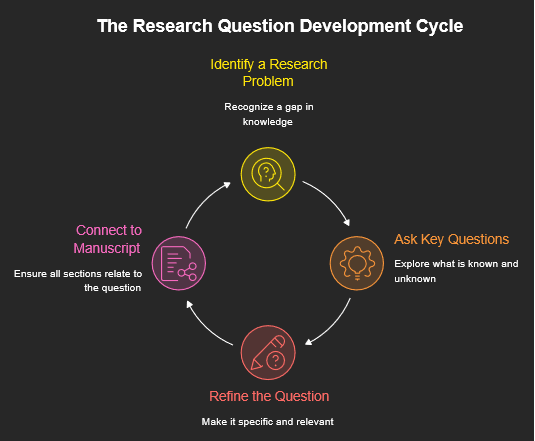
The first step is not opening a blank Word document. It is identifying a research problem worth answering.
A useful research question should be specific, relevant, and answerable with available methods and resources. Begin by asking:
- What is already known?
- What remains uncertain?
- Why does that uncertainty matter?
- What specific question will this study answer?
- What evidence would support or challenge the proposed explanation?
A broad topic such as “plant-based treatments for inflammation” is not yet a research question. A more useful question might examine whether a specific plant extract affects defined inflammatory markers in a particular experimental model.
This distinction matters because a strong question becomes the backbone of the entire manuscript. Your hypothesis, methods, results, discussion, and conclusion should ultimately connect back to it.
2. Map the Literature Before Designing the Study
Once you have a research question, investigate what has already been done.
Do not read papers randomly. Build a structured literature map. Identify major findings, competing explanations, commonly used methods, limitations, and unanswered questions. Pay particular attention to recent systematic reviews and high-quality primary research, while also tracing important older studies.
A literature review should help you identify the gap, not merely demonstrate that you have read many papers.
A useful way to organize your reading is to create a table containing the study objective, model or population, methods, major findings, limitations, and relevance to your research question. Patterns become much easier to see when the literature is organized rather than stored as a collection of PDFs.
At the end of this stage, you should be able to explain your study in one sentence:
“Previous research has established X, but Y remains unclear; therefore, this study investigates Z.”
That sentence can later become the conceptual foundation of your Introduction.
3. Design the Study Around the Question
A compelling research question cannot compensate for weak methodology.
Before collecting data, determine what study design, controls, sample size, measurements, and statistical methods are appropriate. Define your primary outcomes before the experiment begins whenever possible.
Think about reproducibility at this stage. Another competent researcher should be able to understand what you did and, ideally, repeat it.
For experimental studies, document important details such as materials, instruments, concentrations, experimental conditions, controls, inclusion or exclusion criteria, and analysis procedures. For clinical or human research, ethical approval, consent, registration, and reporting requirements may be essential.
4. Analyze the Data Before You Write the Story
After data collection, resist the temptation to immediately write a conclusion.
First, clean and inspect the dataset. Check for missing values, inconsistencies, outliers, measurement errors, and deviations from the original protocol. Then perform the statistical analysis appropriate to your design and research question.
Importantly, distinguish between statistical significance and scientific importance. A small p-value does not automatically mean that a finding is practically meaningful. Report effect sizes, uncertainty, confidence intervals, and other relevant measures where appropriate.
Keep a record of your analysis decisions. If multiple analyses were performed, be transparent about which were planned and which were exploratory.
The goal is not to make the results “look significant.” The goal is to determine what the data actually support.
5. Build the Paper Around the Evidence
Only after understanding the results should you construct the manuscript.
A conventional research paper follows the logic of Introduction → Methods → Results → Discussion, often referred to as the IMRaD structure.
Introduction: What problem are you solving?
Move from the broad scientific context toward the specific research gap. End with a clear objective, research question, or hypothesis.
Methods: How did you answer it?
Provide enough detail for readers to evaluate the validity of the work and, where appropriate, reproduce it. Avoid unnecessary background information that belongs in the Introduction.
Results: What did you find?
Present the evidence without turning the Results section into an extended interpretation. Use tables and figures when they communicate information more efficiently than text.
Discussion: What does it mean?
Interpret the findings in relation to previous research. Explain possible mechanisms, similarities or differences with earlier studies, strengths, limitations, and implications.
A useful rule is:
Results tell readers what happened. Discussion explains why it matters.
6. Write the Abstract and Title Strategically
Although the abstract appears first in a published paper, it is often easier to write it last.
A strong abstract should communicate the research problem, objective, essential methods, principal findings, and conclusion without unnecessary detail. Do not introduce claims that are absent from the main manuscript.
The title deserves equal attention. It should be specific enough to communicate the subject and study design without becoming overloaded with technical terminology.
Remember that the title and abstract are often the first—and sometimes the only—parts of your research that potential readers see. They influence discoverability, readership, and whether researchers decide to read the full article.
7. Choose the Journal Before You Submit
Journal selection should not be treated as an administrative task at the end of the project.
Before submission, evaluate journals based on scope, readership, article type, methodological expectations, publication model, indexing, editorial standards, and typical article content.
A common mistake is choosing a journal solely because it has a high impact factor. A prestigious journal that is poorly aligned with your manuscript may be a worse choice than a specialized journal whose readers actively need your research.
Read several recent papers from potential journals. Ask:
- Does the journal publish studies similar to mine?
- Is my manuscript within its scope?
- Does it accept my article type?
- Are the methods and level of novelty appropriate?
- Who is likely to read the paper?
Good journal selection increases the probability that the manuscript reaches the right reviewers and audience.
8. Perform a Pre-Submission Audit
Before clicking “Submit,” conduct a final quality check.
Verify the journal's author guidelines, formatting requirements, word limits, reference style, figure specifications, supplementary-material requirements, ethical declarations, data availability statements, and submission documents.
Then check the manuscript scientifically:
- Do the objectives match the conclusions?
- Are all claims supported by evidence?
- Are tables and figures consistent with the text?
- Are statistical methods reported clearly?
- Are references accurate and relevant?
- Have limitations been acknowledged?
- Is the manuscript understandable to someone outside your immediate research group?
A colleague who was not involved in the study can provide especially valuable feedback at this stage.
9. Submit, Respond, Revise—and Learn
Peer review is not necessarily a judgment that your research has failed. It is part of the scientific quality-control process.
If reviewers request revisions, read their comments carefully before responding. Separate major scientific concerns from minor editorial corrections. Address each substantive point directly and provide a clear explanation when you disagree.
A strong response letter is professional, specific, and evidence-based. Do not treat reviewer criticism personally. Even a rejection can reveal weaknesses in the manuscript, identify a better target journal, or improve the next version of the work.
Publication is therefore not the final step in research communication. After publication, researchers should consider how their findings can be shared responsibly through conferences, institutional repositories, research networks, and appropriate academic platforms.
The Workflow Is a Loop, Not a Straight Line
The ideal research-paper workflow is not simply:
Idea → Experiment → Paper → Journal → Publication
It is a connected cycle:
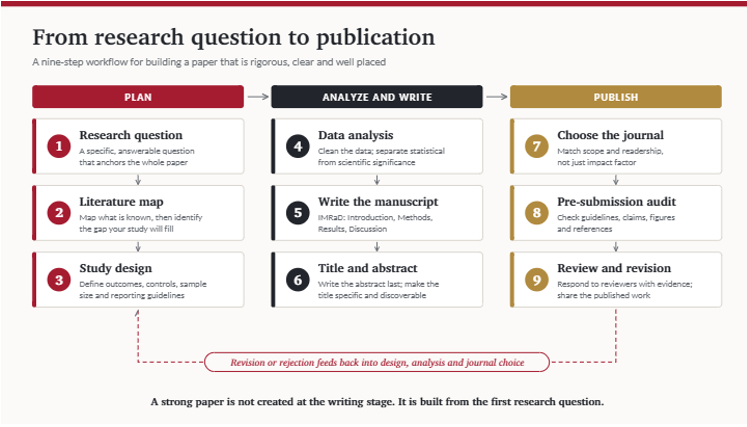
Research question → Literature gap → Study design → Data → Analysis → Manuscript → Journal selection → Peer review → Revision → Publication
Each stage influences the next. A poorly defined question can produce unfocused experiments. Weak study design can limit the strength of the conclusions. Poor journal selection can lead to unnecessary rejection. And unclear writing can hide excellent science.
The most effective researchers therefore think about publication from the beginning—not by designing studies merely to satisfy journals, but by designing rigorous research that can be communicated clearly to the right scientific audience.
A strong paper is not created at the writing stage. It is built from the first research question.
Comments
No comments yet — be the first to share your thoughts.