The Journal Publishing Market: No Longer Just Research, Now a Multi-Billion-Dollar Business
Publishers collect fees from authors, from libraries, and sometimes from both. The journal publishing market turns your manuscript into revenue long before anyone cites it. Most researchers only see that business side when an invoice arrives.
What the Journal Publishing Market Actually Sells
Think of a journal as a restaurant with an unusual kitchen. Researchers supply the ingredients and cook the meal. Other researchers taste it and suggest changes, usually for free.
The publisher runs the dining room. It handles editing, hosting, indexing, and the brand above the door. Then it charges someone for a seat.
For decades, that someone was the library. Universities paid large subscription fees so students and faculty could read. Open access publishing added a second model, where authors or funders pay article processing charges instead.
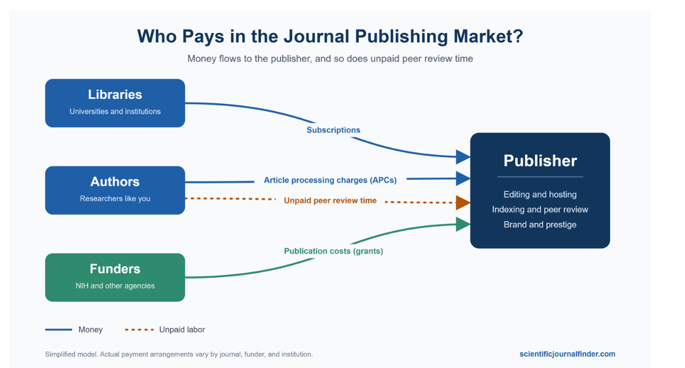
The scale supports multi-billion-dollar businesses. Today, publishers also sell analytics tools, databases, and data services alongside journals. The journal stays at the center because it carries the prestige.
That mix explains why publishing behaves like any other large industry, with competition, consolidation, and pricing strategy.
Publishers are not villains in this story. Good editing, archiving, and peer review management cost real money. The debate is about balance, not about whether publishing should cost anything.
Understanding that structure changes how you read every journal's website.
Why the Money Trail Matters to Your Career
Fees shape where you can publish and what you can afford. A journal with a high charge may be out of reach without grant support. A journal with no charge may lack the prestige your committee expects.
Funders have noticed. In July 2025, NIH announced plans to cap what it pays toward publication costs, pointing to fees of up to $13,000 per article at some major publishers. Its request for information floated several options, including disallowing publication costs entirely.
Check the current NIH guidance before you budget, because the final policy may differ from the proposals. Skip that step and you may learn about a fee only after acceptance. That is a painful moment to discover your grant does not cover it.
Early-career researchers feel this most. You often have the least funding and the most pressure to publish. Budget for publication the same way you budget for reagents.
Fees also affect speed, since a funding gap can stall a submission for weeks.
Ask the same questions of every journal: who pays, how much, and when?
Common Mistakes About the Publishing Business
Mistake one is assuming a high price means high quality. Fees reflect brand, costs, and market position. They do not guarantee rigorous review.
Mistake two is assuming open access publishing means low quality. Many reputable journals are fully open access. Judge a journal by its editorial practices, not its payment model.
Mistake three is saying yes to the first fast offer. Predatory journals exploit deadlines and the pressure to publish. They promise quick acceptance and collect fees for work they barely do.
Mistake four is skipping the checks. Think Check Submit walks you through questions about a journal's editors, policies, and transparency. You can also look a title up in the Directory of Open Access Journals.
Mistake five is paying twice without noticing. Some hybrid journals combine subscription income with author fees. Read the fee page closely before you agree to anything.
A common version of this mistake is discovering an unexpected charge at the proofing stage. Ask about every fee in writing before you submit.
Five Steps to Publish Smart in the Journal Publishing Market
Most surprises come from skipping the homework. Work through these steps before you write your cover letter.
-
Write two sentences describing your manuscript's topic and audience. Keep them specific. This keeps your search focused on journals your readers actually use.
-
List journals that match your scope. Confirm each one appears in an index your institution respects, such as Scopus or Web of Science. Indexing alone does not prove quality, but it is a useful first filter.
-
Read the fee page on each journal's website. Note any charge at submission or after acceptance. Screenshot it for your records.
-
Ask your library or funder about fee coverage. Some institutions have publisher agreements that lower or remove author fees. Ask early, since approvals can take time.
-
Run the Think Check Submit questions on your top choices. Drop any journal that fails, since predatory journals often fail several at once. Keep notes on each answer.
Ten minutes of checking can save you months of regret. Do it early, while you still have options. A short spreadsheet makes the comparison easy.
A Shift Worth Watching: Funders Push Back on Fees
Funders are starting to push back on publishing costs. NIH's Public Access Policy makes papers from NIH-funded studies free to read immediately, with no embargo period. That puts attention on how researchers comply and what it costs.
To study fees, NIH analyzed average article processing charges using data from the Directory of Open Access Journals. The result was a proposal to limit what grants can pay.
Authors have a low-cost route too. You can deposit your accepted manuscript in PubMed Central instead of paying for open access. Check your funder's rules and your target journal's policy first.
Universities are paying attention too. Many libraries now negotiate publisher agreements that bundle reading access and author fees.
Expect this debate to continue through 2026. Publishers, libraries, and funders are all renegotiating who pays. Your choices as an author are part of that pressure.
Watch for updates from NIH and your own institution.
How Scientific Journal Finder Makes This Easier
Picking a journal means weighing scope, indexing, fees, and reputation all at once, and tracking every detail by hand quickly becomes tedious and error-prone. A good matching tool narrows the field, so you can spend your time vetting a short list of journals that genuinely fit your work. Use it to find the right journal for your manuscript, then run the fee and integrity checks from this post on your top three picks.
Search your manuscript topic at scientificjournalfinder.com and find your best-matched journal in seconds.
The Bottom Line for Researchers
The journal publishing market is big, commercial, and built partly on your work. Understanding how it earns money helps you choose journals with clear eyes. Before your next submission, write down the fee, the index, and the integrity check result for each journal on your list, then submit with a clear plan.**
The Journal Publishing Market: No Longer Just Research, Now a Multi-Billion-Dollar Business**
Comments
No comments yet — be the first to share your thoughts.